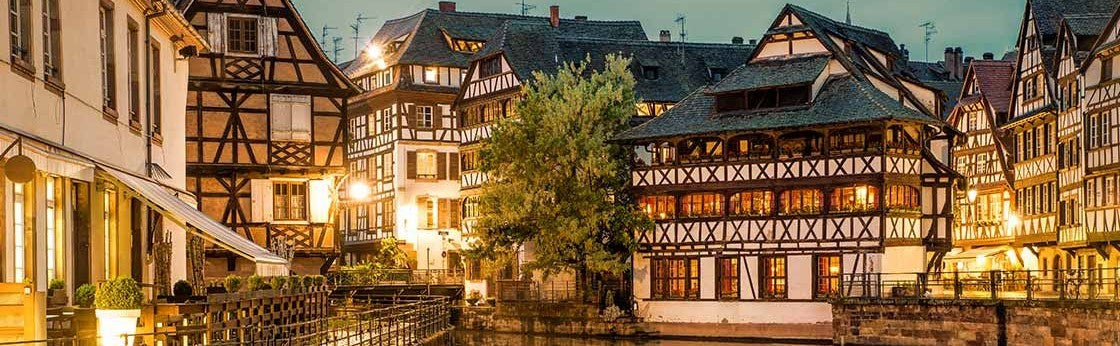
Alsace, in the far north-eastern corner of France, stands out from other French wine regions thanks to its strong Franco-Germanic influences. These are the results of the region having switched back and forth between German and French sovereignty in recent centuries – and are evident not only in Alsatian architecture and culture, but also in the wines.
The Alsace region lies between the Vosges mountains and the French border with Germany, marked by the Rhine river. A long, thin region, it measures 185 kilometers (115 miles) north to south and just 40km (25 miles) from east to west. The key viticultural areas here are all located on the lower hillsides of the Vosges, on slopes with east and south-easterly aspects.
The Vosges play a vital role in defining the region's terroir; they not only provide protection from the prevailing westerly winds, but also cast a rain shadow over the area, contributing to the low rainfall of its continental climate. They are at their most dense in the southern half of Alsace, where the peaks reach roughly 1400 meters ( 4600ft).
The glacial activity which created the mountains has also significantly impacted the region's topography and soils. These vary from sandstone, granite and volcanic rock types in the foothills, to clay-rich limestone and marlstone on the alluvial plains below.